
Where did my job applications go? Reading the flow
Unanswered, rejected without an interview, or through to one: how to map where your applications went and what each branch of the flow tells you.
After a few dozen applications, most people are left with one feeling: "none of them ever answered." Sometimes that is true, often it is not — but you cannot tell which, because your applications are scattered across a few sites' "my applications" screens, an inbox and your memory.
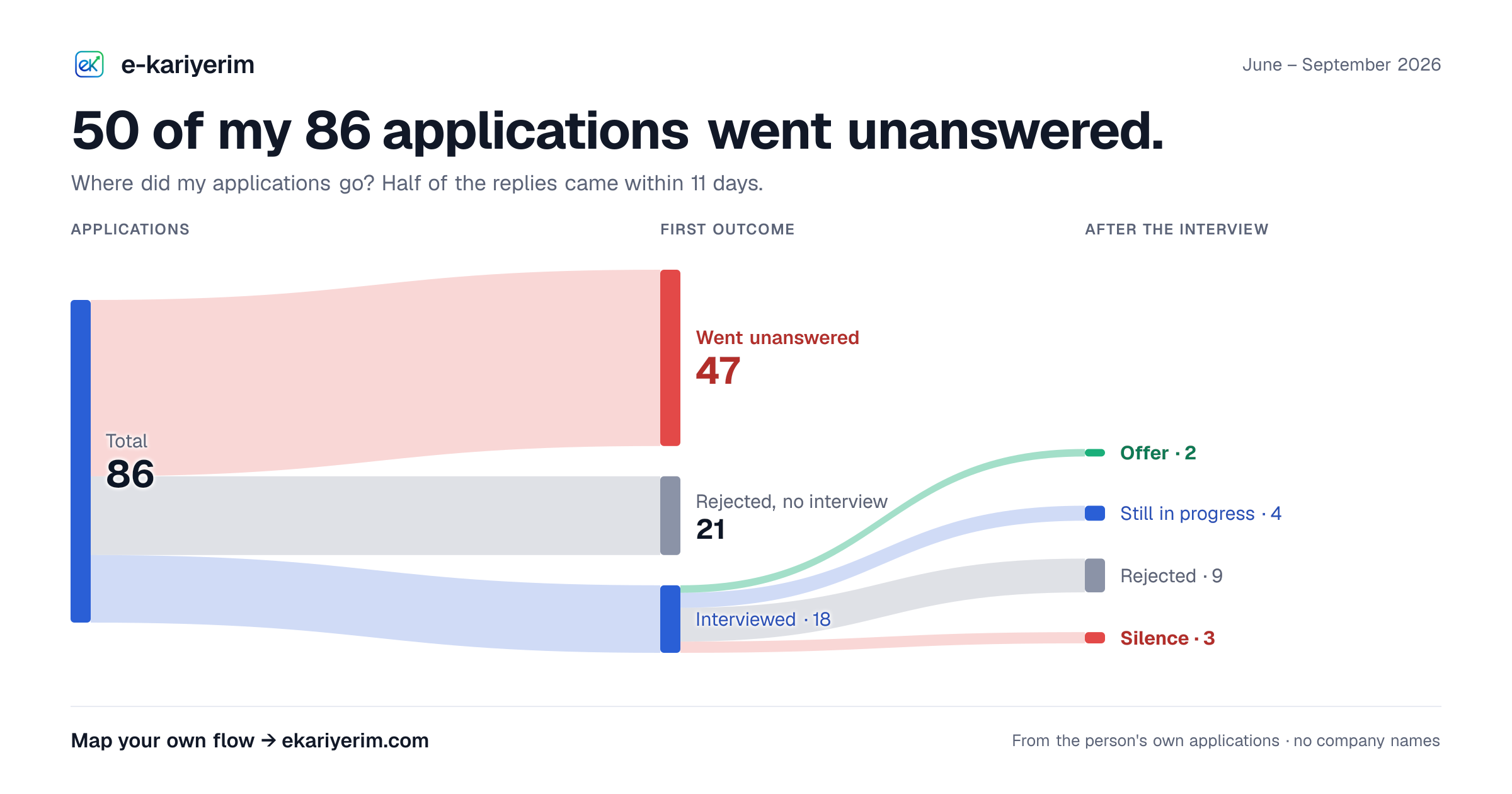
An application flow turns that scatter into one picture: how many applications you sent, where each one landed, and what happened to the ones that reached an interview. The card below is an example of one.
How to read the flow
The card has three columns, left to right. Ribbon widths are proportional to the number of applications.
Applications. Every application in the period you chose, as one column.
First outcome. Each application lands in exactly one of these boxes: went unanswered, awaiting a reply, rejected without an interview, in screening, withdrawn, or interviewed. Nothing is counted twice and nothing goes missing — this column always adds up to the first one.
After the interview. Only the applications that reached an interview carry on here: offer, still in progress, rejected, silence, or withdrawn. This column adds up to the "interviewed" box.
In the example, 47 of 86 applications went unanswered, 21 were rejected without an interview and 18 reached one. Of those 18, 2 ended in an offer and 9 in a rejection, 4 are still going, and 3 never heard back after the interview. That is why the headline says 50 unanswered: 47 + 3, the ones that never got a reply plus the ones that went silent after an interview.
Where "unanswered" ends and "awaiting a reply" begins
No reply to an application you sent yesterday means nothing. So the flow splits applications by age: those sent in the last 30 days count as awaiting a reply, and those older than 30 days that have seen no movement count as unanswered.
The 30 days are not arbitrary; they are the same thresholds as in how long to wait after applying: the first real screening usually happens in the second week, and an application past 30 days with no movement is, in practice, closed. Now and then a reply does come much later, and the application simply moves to the right box.
What each branch is telling you
The point of the flow is to show you where the thickest branch is. Each one points at a different stage:
- If "went unanswered" is the thickest: your application is most likely not reaching a person. Look at the first screen of your CV, the level of the roles you target, and how old the postings are. This branch is thick for most people; on its own it is not bad news, but if it does not thin out over time, something needs to change. How to read that number is in how many job applications it takes.
- If "rejected without an interview" is thick: your CV is being read but stops at screening. That is about fit more than visibility. Some rejection emails carry a real reason; which ones do is in what a rejection email actually tells you.
- If there are interviews but no offers: the problem is not the first screen, it is the interview stage. More applications will not fix that; preparing differently for interviews will.
- If there is silence after interviews: that is not your failing. Once there has been an interview, the company owes you an answer; if the date they gave has passed, asking is entirely fair.
A card is one person's applications. Use it not to race someone else's card but to see how your own flow changes over time: the last 30 days, the last 90 days and all time tell different stories side by side.
Mapping your own flow
You can do it by hand. For each application, keep the date, the latest status and whether it reached an interview — the job application tracker spreadsheet is built for that. Then count the applications into the boxes above: first outcome first, then the outcome of the ones that reached an interview. If the totals add up, your flow is right.
The hard part is not the counting, it is keeping it current: replies arrive by email, statuses change on the sites, and the most important fact — that a reply did not come — leaves no record anywhere. That is why e-kariyerim exists: it keeps your applications in one place, matches the replies in your Gmail to them, counts the ones past 30 days as unanswered by itself and draws your flow on the dashboard. Once you have at least 10 applications you can share your flow as a card.
What a shared card does and does not contain
A card holds numbers and the period (month and year) only. No company names, no job titles, nothing about your name or your account appears on the card or in its link; the link does not say who shared it. Shared card pages and their images are kept out of search engines — a card is for the people you chose to share it with.
You don't have to track this by hand
e-kariyerim keeps your applications in one place, counts how long each one has been waiting, and updates the status itself when a reply arrives. Free.
Get started free